UGC Guidelines for PhD Thesis Submission (2020 Regulations with Latest Updates)
A complete and detailed explanation of UGC PhD Regulations 2020 with latest updates till 2025. Covers eligibility, duration, coursework, plagiarism limits, publication rules, thesis submission process, evaluation, and viva-voce.
Table of Contents
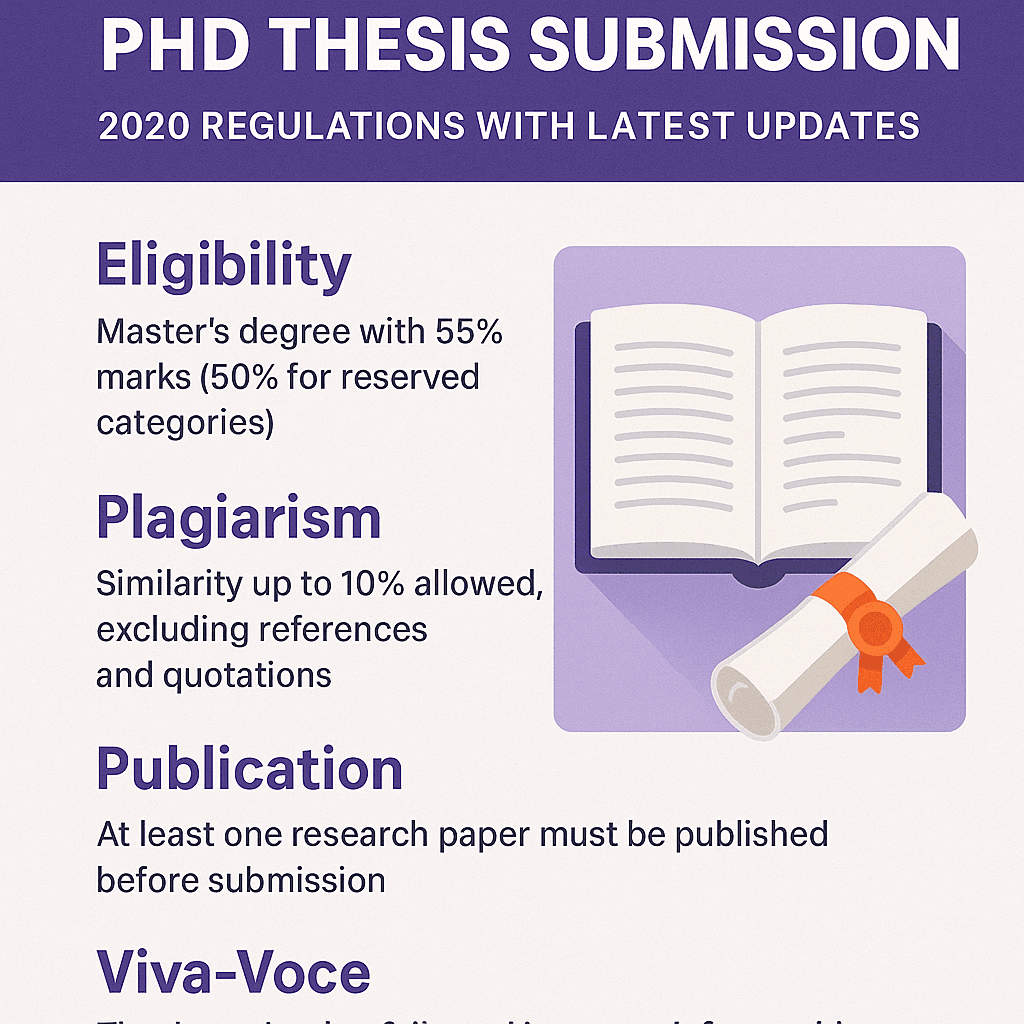
UGC PhD Regulations 2020 – Key Highlights
- Minimum duration of PhD: 3 years (including coursework)
- Maximum duration allowed: 6 years from registration
- Minimum eligibility: Master's degree with 55% marks (50% for reserved categories)
- Mandatory coursework for all PhD scholars
- Acceptable plagiarism limit: Up to 10% (excluding references)
- At least one research paper publication required before thesis submission
- Thesis submission only after pre–submission seminar and plagiarism clearance
- Final evaluation through external examiners and viva–voce
Introduction
Doctoral research represents the highest level of academic inquiry in higher education. In a country like India, where thousands of PhD scholars enroll every year across disciplines, maintaining uniform standards becomes essential. The University Grants Commission (UGC) plays a critical role in ensuring that PhD programs across universities are credible, ethical, and globally acceptable.
To address concerns such as inconsistent admission practices, excessive delays in thesis submission, rising plagiarism cases, and non–uniform evaluation systems, UGC introduced the PhD Regulations in 2020. These regulations remain the backbone of doctoral education even today, with minor updates and clarifications applicable till 2025.
What Are UGC PhD Regulations 2020?
The UGC (Minimum Standards and Procedure for Award of PhD Degree) Regulations, 2020 provide a legally binding framework that every UGC–recognized university must follow. These rules are designed to protect academic integrity while ensuring that PhD research produces original and meaningful contributions to knowledge.
The regulations clearly define eligibility, coursework requirements, permissible plagiarism limits, publication mandates, thesis submission procedures, and the final viva–voce examination process. Universities are allowed to add stricter conditions, but they cannot relax or violate the minimum standards laid down by UGC.
Is UGC PhD Regulation 2020 Still Valid in 2025?
Yes, the UGC PhD Regulations 2020 are still valid and fully applicable in 2025. The University Grants Commission has not withdrawn or replaced these regulations. Instead, UGC has issued minor procedural clarifications and digital–process updates while retaining the core academic framework.
Key provisions related to eligibility criteria, minimum and maximum duration of the PhD program, compulsory coursework, plagiarism limits, research publication requirements, thesis evaluation, and viva–voce examination remain unchanged.
Universities are permitted to introduce additional administrative rules or digital submission processes. However, they are not allowed to relax, bypass, or contradict the minimum standards prescribed under the UGC PhD Regulations 2020.
Therefore, any PhD scholar who is registered or planning to register for a PhD program in India must strictly follow the UGC 2020 regulations, along with university–specific ordinances aligned to these norms.
Who Should Follow UGC PhD Regulations 2020?
The UGC PhD Regulations 2020 are mandatory for all scholars pursuing a PhD from UGC–recognized universities in India. These regulations apply uniformly across disciplines and institutions to ensure quality, transparency, and academic integrity in doctoral research.
The guidelines must be followed by the following categories of research scholars:
- Full–time PhD scholars enrolled in universities or research institutions
- Part–time PhD scholars, including working professionals
- Research scholars registered under government or private universities
- Interdisciplinary and industry–sponsored PhD candidates
Irrespective of the subject area—science, commerce, arts, management, law, education, or interdisciplinary studies—compliance with UGC regulations is compulsory for the award and recognition of a PhD degree in India.
Eligibility Criteria for PhD
According to UGC norms, a candidate must possess a Master's degree with a minimum of 55% marks. Candidates belonging to SC, ST, OBC (non–creamy layer), EWS, and PwD categories are eligible with a minimum of 50% marks. Admission must be through a recognized entrance examination such as UGC–NET, CSIR–NET, GATE, or a university–level test.
While universities may design their own admission processes, they are not permitted to dilute these minimum eligibility standards. This ensures fairness and uniform academic quality nationwide.
Duration of PhD Program
The minimum duration of a PhD program is three years, including coursework. The maximum duration is six years from the date of registration. Extensions may be granted only under special circumstances as per institutional policies.
PhD Admission & Registration Timeline
Follow this step–by–step process for a smooth UGC–compliant PhD registration:
- Step 1: Check eligibility (Master's degree + entrance exam qualification)
- Step 2: Apply to university and clear interview/departmental screening
- Step 3: Complete registration formalities and receive enrollment number
- Step 4: Undertake mandatory coursework (credits as per university)
- Step 5: Choose supervisor and submit research proposal
- Step 6: Mid–term progress evaluation (every 6–12 months)
- Step 7: Pre–submission seminar and plagiarism clearance
- Step 8: Thesis submission and viva–voce
Tip: Keep all documents, approvals, and progress reports properly filed for university compliance and UGC audit.
Coursework & Credit Structure
All PhD scholars must complete mandatory coursework before thesis submission. Below is the typical credit structure followed by most universities:
| Course/Subject | Credits | Evaluation |
|---|---|---|
| Research Methodology | 4 | Written Exam + Assignment |
| Advanced Research Techniques | 3 | Project/Presentation |
| Domain–Specific Elective | 3 | Internal Assessment |
| Seminar/Presentation Skills | 2 | Seminar Evaluation |
Note: Exact courses and credits may vary by university, but completing all coursework is mandatory before pre–submission seminar.
Plagiarism Guidelines
Plagiarism is treated as a serious academic offence. Most universities strictly enforce a similarity limit of up to 10%, excluding references and quotations. Scholars are advised to check plagiarism multiple times during writing rather than waiting until final submission. For practical strategies, refer to our detailed guide on PhD plagiarism reduction techniques.
| Up to 10% | Acceptable |
| 10% – 40% | Minor plagiarism (revision required) |
| 40% – 60% | Major plagiarism |
| Above 60% | Severe plagiarism (rejection possible) |
Common Mistakes PhD Scholars Make Under UGC Regulations
Despite the clarity of UGC PhD Regulations 2020, many research scholars face unnecessary delays, repeated revisions, or even rejection of their thesis due to avoidable mistakes. In most cases, these issues arise not because of weak research, but due to poor understanding or late compliance with UGC norms.
Some of the most common mistakes observed across Indian universities are listed below:
- Ignoring plagiarism checks until the final stage: Many scholars write the entire thesis first and check plagiarism only at the end, resulting in high similarity that becomes difficult to reduce.
- Publishing in non–UGC or predatory journals: Papers published in journals not recognized by UGC–CARE are often rejected during thesis submission.
- Incomplete coursework documentation: Missing coursework completion certificates or internal assessment records can delay submission.
- Poor formatting and referencing: Even strong research can be returned if thesis formatting does not follow university guidelines.
- Skipping proper pre–submission approval: Conducting the pre–submission seminar as a formality without proper documentation may lead to rejection during administrative scrutiny.
To avoid these issues, scholars should familiarize themselves with UGC regulations at the beginning of their PhD journey and maintain proper records, approvals, and plagiarism checks at every stage of research.
Frequently Asked Questions (FAQs)
Are UGC PhD Regulations 2020 still valid?
Yes. The UGC PhD Regulations 2020 are still valid and applicable across all UGC–recognized universities in India. Although UGC has issued minor procedural and digital updates over the years, the core regulations related to eligibility, duration, plagiarism limits, publication requirements, and viva–voce remain unchanged even in 2025.
What is the maximum plagiarism allowed in a PhD thesis as per UGC?
As per UGC guidelines, similarity up to 10% is generally considered acceptable after excluding references, bibliography, and quoted material. Similarity between 10% and 40% is treated as minor plagiarism and requires revision, while higher similarity may lead to serious consequences including rejection.
Is research paper publication mandatory before PhD thesis submission?
Yes. UGC mandates that at least one research paper must be published in a UGC–CARE listed journal or a reputed peer–reviewed journal before final thesis submission. Some universities may require two publications, but they cannot reduce the minimum requirement prescribed by UGC.
Can a university change UGC PhD rules?
Universities are allowed to introduce additional rules or stricter procedures for administrative convenience. However, they are not permitted to relax, violate, or contradict the minimum standards prescribed under UGC PhD Regulations 2020.
Is coursework compulsory for all PhD scholars?
Conclusion
The UGC Guidelines for PhD Thesis Submission 2020 were introduced to strengthen the credibility of doctoral research in India. Scholars who understand and follow these regulations carefully can avoid unnecessary delays, rejection, and academic stress.
Official UGC Reference
The information provided in this article is based on the official University Grants Commission (UGC) notifications and regulations governing the award of PhD degrees in India. Scholars are advised to consult official university circulars in addition to UGC guidelines for institution–specific procedures.
- UGC (Minimum Standards and Procedure for Award of PhD Degree) Regulations, 2020
- UGC Public Notices and Circulars related to doctoral research (2021–2025)
- Shodhganga: Indian ETD Repository (INFLIBNET)
Need Professional PhD Guidance?
Get expert help with UGC–compliant thesis writing, plagiarism reduction, and publication support.
Book Consultation →About the Author
Dr. Poonam Khamar Shah is an academic consultant and PhD research guide with over a decade of experience in UGC–compliant doctoral research. She has supported hundreds of PhD scholars across Indian universities in thesis writing, plagiarism reduction, UGC regulations compliance, and successful thesis submission.
This article is written and reviewed in accordance with official UGC PhD Regulations 2020 and subsequent procedural updates applicable till 2025.
Know more about the author →