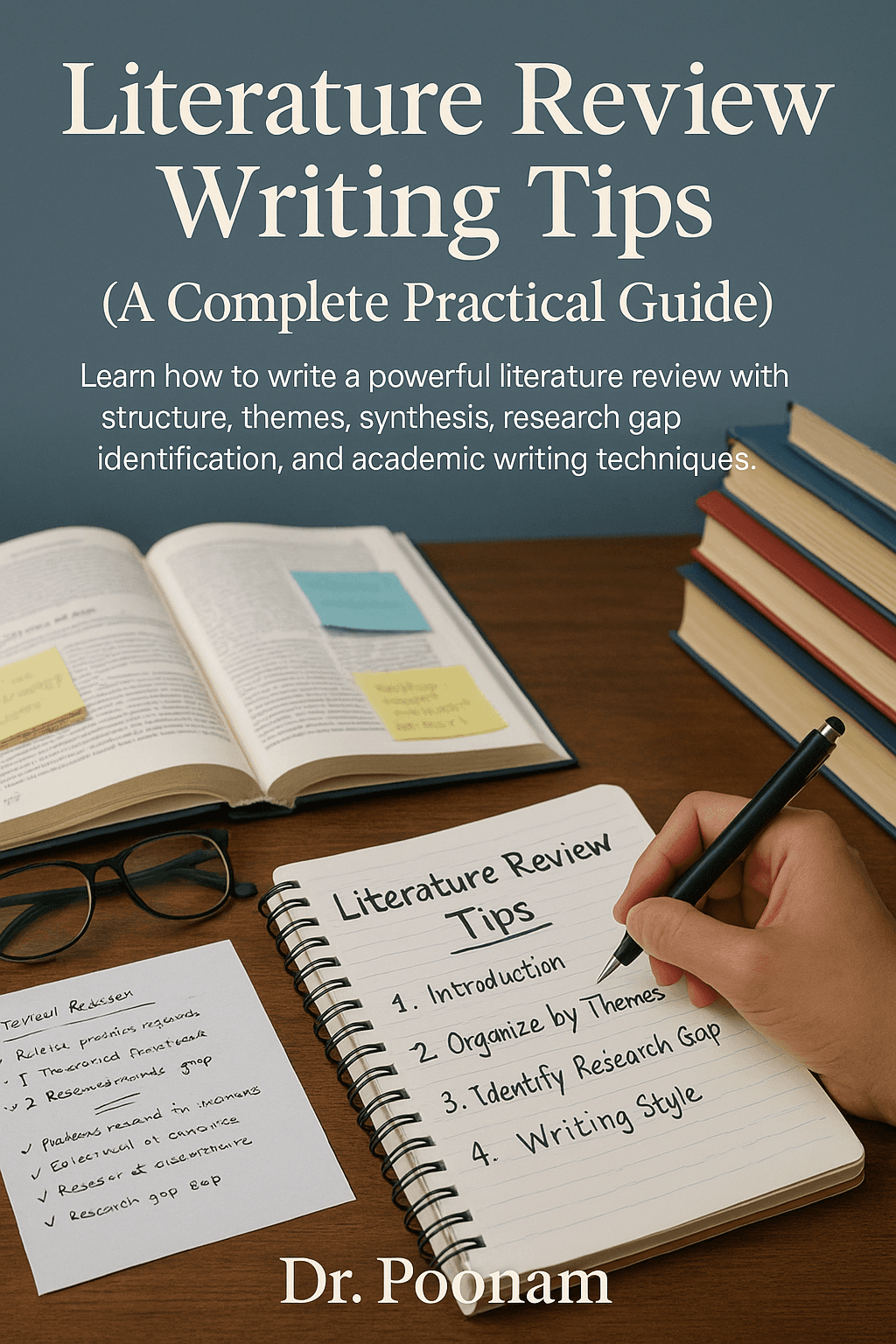
What Is a Literature Review?
A literature review (LR) is not just a summary of past research — it is a structured academic discussion that connects themes, gaps, contradictions, and findings from published studies. A strong LR forms the foundation of your thesis or dissertation. It shows that you understand what has already been studied, what is missing, and where your work fits in.
1. Purpose of a Literature Review
A good literature review accomplishes the following:
- Explains what is already known in the field
- Identifies research gaps
- Highlights contradictions in previous studies
- Builds theoretical and conceptual understanding
- Justifies why your study is needed
2. How to Collect the Right Research Papers
Finding the right papers is critical. Do not collect random PDFs — focus on high-quality sources.
Best Sources:
- Google Scholar
- Scopus-indexed journals
- Springer, Elsevier, Taylor & Francis
- ResearchGate (for recent working papers)
Search using combinations like:
- "online learning" AND "student motivation"
- "customer satisfaction" AND "service quality"
- "employee productivity" AND "remote work"
3. How to Organize Your Literature Review
The biggest mistake students make is writing LR paper-by-paper. Instead, you should organize it theme-wise.
Example Structure:
- Theme 1 — Past findings
- Theme 2 — Conflicting results
- Theme 3 — Emerging trends
- Theme 4 — Identified research gap
This structure helps the reader understand the logical flow of research.
4. How to Write Critical Evaluation (Not Just Summary)
Instead of writing:
"Sharma (2020) studied online learning and found X."
Write this:
"Sharma (2020) reported improved academic performance, but Singh (2021) contradicts this by highlighting negative effects on attention span. This disagreement indicates that outcomes depend heavily on student learning styles."
This is called critical synthesis, the key to a strong LR.
5. How to Identify the Research Gap
A research gap is the missing link that your study will address. It is the backbone of your thesis.
Ways to spot a gap:
- Limited sample sizes in previous studies
- Outdated research (older than 5 years)
- Missing variables or dimensions
- Studies focused on foreign context (not India)
- Contradictory findings
Your thesis becomes meaningful when it solves a gap everyone else ignored.
6. Ideal Length of Literature Review
For most students:
- Undergraduate thesis: 6–10 pages
- Master's dissertation: 12–20 pages
- Ph.D. thesis: 25–40 pages
7. Literature Review Writing Style
Your writing must be formal, academic, and analytical. Avoid personal opinions and emotional language.
Use this style:
- Write in paragraphs, not bullet summaries
- Compare studies, don't list them
- Use transition words: however, therefore, in contrast, similarly
- End with a strong research gap paragraph
8. Common Mistakes to Avoid
- Copy-paste from journals (plagiarism)
- Writing one paragraph per author
- No connection between paragraphs
- Ignoring contradictions in literature
- No research gap section
9. Final Literature Review Checklist
- Do paragraphs flow logically?
- Are all themes organized properly?
- Is the research gap clearly written?
- Are references recent (not older than 5 years)?
- Is the writing analytical, not descriptive?
Need Help Writing Your Literature Review?
Get personalised guidance from Dr. Poonam. Learn theme-wise writing, research gap finding, and academic flow structure.
Book Assistance →